

 Posts
Posts


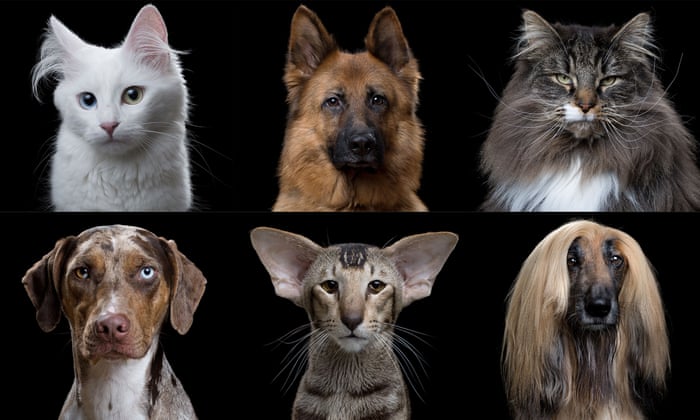
“By and large, people who enjoy teaching animals to roll over will find themselves happier with a dog.”
—From Secrets of the Cat by Barbara Holland
Similarities Between Cats and Dogs
Alerts. Both will warn us of danger. In the case
of cats, this is more apt to mean fires, gas leaks, and children in
distress, but I knew a woman whose cat alerted her to the presence of a
burglar while the woman’s dog hid under the couch.
Friendship. Both have the capacity to love humans, members of their own species, and members of other species.
Homing. Both dogs and cats have completed solitary journeys. For example, Peggy’s mother gave away a Scotty that returned home from across town, and a northwest Georgia cousin gave me a cat that returned to Georgia from southwest Mississippi, a direct-line distance of 400 miles (the first thing he did upon arriving was to run to where his food bowl had been).
Hunting. Both hunt with intelligence, patience, and stealth.
Insight. When I fell headlong while jogging across a parking lot one night, my two dogs occupied themselves with smelling the asphalt while I struggled to catch my breath. Generally speaking, cats are equally oblivious to my distress.
Intelligence. Researchers say that the two species are about equal. It seems to me that individuals within a species differ more than the species themselves do.
Loyalty. Both are loyal until death.
Luxury. Both enjoy good food, soft beds, massages, and naps before a heater or in the sunshine.
Persistence. A dog will stay on task until his human forces him from it. A cat will stalk her prey until she captures it or success becomes impossible.
Protectiveness. By virtue of their larger size, dogs are better able to fight for us, but cats have also risked life and limb in our defense.*
Resourcefulness. Herding dogs and curious cats are testaments to ingenuity.
Tolerance. Dogs and cats are more accepting of our failures, preferences, and eccentricities, than are our human friends.
Differences Between Dogs and Cats
Adaptability. Dogs enjoy adventuring with their humans. Cats are homebodies who want everyday to be the same.
Affection for their kind. Dogs prefer the company of humans to that of other dogs. My cats, at least, prefer the company of one another, perhaps because sleeping is their favorite activity, and they feel safe and warm with their bodies touching.
Claws. Cats have claws that climb, grasp, blind, and eviscerate. Dogs have toenails that serve as cleats on soft ground but are useless on pavement.
Cleanliness. Dogs are indifferent to squalor, and go to their baths as to a guillotine. Cats will pee and poop on the floor if their litter box is filthy and, next to sleeping, bathing is what they do most.
Communication. Most dogs are outspoken. Except when their meal is delayed, most cats are subtle.
Dignity. Many cat lovers proclaim dignity as a major feline virtue, but I believe that dignity varies more between individual dogs and cats than between the two species. It also seems to me that both species are more dignified than is our own.
Forgiveness. A dog will lick the hand that strikes him. A cat will run from it.
Genetic differences. All human-created dog breeds have genetic weaknesses, some of which lead to lives that are short and miserable. Cats have largely escaped this fate, although scientific advances are making abuses possible.
Grace and agility. Assuming youth and vigor, the grace and agility of the world’s clumsiest cat probably exceeds that of the most agile and graceful dog.
High places. Dogs fear heights. Cats so love them that vets have coined the term high rise syndrome to describe the fate of cats who become overly confident in their climbing prowess.**
Hunting. Packs of dogs ambush their prey and run it to ground. Solitary cats blindside unsuspecting prey with speed and agility.
Intelligence. Dogs show intelligence by doing the bidding of humans. Cats show intelligence by thwarting humans in favor of private goals.
Injury. Cats have thin bones that make them susceptible to injury, yet they are far more likely than dogs to survive falls, and they actually survive long falls better than short ones.***
Killing. Dogs wound and kill with their teeth. Cats wound with teeth and claws before killing with their teeth. Dogs kill swiftly. Cats bat their prey about in order to hone their hunting skills.
Obedience. A dog will move heaven and earth to please his human. A cat will move heaven and earth to please herself. Dogs come running when called. Cats come walking when their treat jar is rattled.
Passing time. My indoor cats sleep, bathe, cuddle,
observe, play, demand food, and eat, pretty much in that order. What
dogs do depends upon upon what they have access to, so the following is
in no particular order: sleep, walk, play, bark, cuddle, entreat, smell
things, and leave urine marks.
Playfulness. Adult dogs require few toys—a tennis ball and a chew/cuddle toy will usually suffice—and they enjoy playing the same games they played as puppies, sometimes for hours a day. Adult cats require a succession of new toys, which they abandon within minutes of receiving them. Cat lovers agree that cats enjoy the box that their $50 toy came in more than they enjoy the toy itself. Among their favorites are laser lights; toys that can be lobbed across a room so the cat can run to it and wait for his human to come and retrieve it; and toys that can be tied to a stick and swung over the cat’s head.
Politics. Dogs are monarchists who view their adult humans as their superiors. Cats are libertarians who, at best, regard their adult humans as their equals.
Purring. There is no canine equivalent to a cat’s purr. Cats purr when they’re happy, sick, frightened, or in pain. Kittens purr differently than adults; some cats purr in one note and some cats purr in more than one note; and all cats purr both on the inhale and the exhale.
Remorse. A scolded dog wants to dig a grave and pull the dirt in after her. A scolded cat interprets being scolded as an unwarranted annoyance.
Reserve. If reserve is important, get a cat, but preferably not a Siamese.
Sharing food. A dog that approaches another dog that is eating commits a serious faux pas. Most cats will share their food with loved ones.
Society. Dogs are a social species. Cats are solitary. Dogs are extroverts. Cats are introverts. Dogs are like humans. Cats are like cats.
Speed and Stamina. Dogs run fast and have excellent aerobic stamina. Cats run slowly and are soon winded.
Stepping over. When a person steps over a resting dog, the dog scrambles to her feet in abject terror. When a person steps over a resting cat, the cat just lies there.
Strength. Cats use their legs to bat their prey around, knock it into the air, and pin it for the kill. The legs of dogs are only good for running.
Togetherness. A dog says to his human, “You are my god, and all I ask of life is to be with you every moment of everyday.” A cat says to her human, “You are my equal, and I insist that you respect my need for alone time.”
Tricks. Dogs throw their entire beings into learning whatever tricks their humans are pleased to teach them. The only trick at which my cats excel is being on time for breakfast, lunch, and dinner. In fact, they prefer that I serve every meal an hour early.
What a dog wants his human to know: “For as long as I live, I will devote every ounce of my being to your happiness. Though it come to pass that the world despise you, I will remain steadfast. If you treat me well, my life will be joyful. If you treat me badly, my life will be miserable, but I will serve you anyway.”
What a cat wants her human to know: “I do my thing and you do your thing.
I am not in this world to live up to your expectations,
and you are not in this world to live up to mine. You are you, and I am I, and if by chance we find each other, it's beautiful.
If not, it can't be helped.”—Fritz Perls
So, Which Is Better?
Despite having made this question the subject of a lengthy post, I contend that the question is no more sensical than asking whether a hammer is better than a screwdriver. What does make sense is to ask oneself the following questions before acquiring any pet:
(1) What jobs do I expect my pet to perform?
(2) What characteristics do I want my pet to have?
(3) Will I have the willingness and the ability to provide for the longterm physical and emotional needs of my pet?
Dogs are versatile and adaptable animals that can perform scores, perhaps hundreds, of specialized services at which no cat can compete, so a dog is the only option for people who require those services. A dog is also the better choice for people whom, for reasons of personality, prefer dogs to cats. However, one must remember that a dog requires considerably more maintenance than a cat.
Cats excel at killing small rodents, so if a person needs a mousekiller, a cat is the only viable option. Likewise, if a person simply wants a companion that is: small, quiet, beautiful, affectionate, self-cleaning, low-maintenance, mysterious, long-lived, non-smelly, pleasing to the touch, comes housebroken, and is capable of warning of certain types of danger, then that person should acquire a cat.
*https://www.youtube.com/watch?v=Dw9AwaJaVGU
** https://en.wikipedia.org/wiki/High-rise_syndrome
***http://www.todayifoundout.com/index.php/2010/11/domestic-cats-can-fall-from-any-height-with-a-remarkable-survival-rate/


